Microfibre, colour-coding and stopping cross-contamination on the job
Red for toilets, blue for general, green for food, yellow for infectious risk — the convention only works if the laundry, the trolley and the night crew all keep the same story.
Editorial desk · 7 May 2025 · Updated 20 January 2026
Cross-contamination is not an infection-control seminar. It is a blue cloth that did a toilet bowl and then did a reception desk because it was the cloth in the hand. Australian commercial work still loses contracts on that habit — a food-court complaint, a ward environmental audit, a school parent who watched the same mop go from the amenity to the canteen. Microfibre and colour-coding are the cheapest engineering you will ever put on a trolley. They fail when they are a poster in the cupboard and a mixed bag in the boot.
This sits with the rest of the chemicals and equipment discipline. A TGA-listed disinfectant with a correct dwell, as we set out in infection control after COVID, does not rescue a cloth that just left a urinal.
The red, yellow, blue and green convention
There is no one Act that paints your cloths. There is a convention that most Australian contractors, trainers and health environmental-services teams will recognise, close to the BICSc / ISSA colour system that cleaning schools have taught for years:
- Red — toilets, urinals, washroom bowls and the wet wall immediately around them.
- Yellow — washroom surfaces that are not the bowl, or infectious / isolation risk, depending on the site procedure. This is the colour that causes the most fights, because some clients use yellow for all washrooms and red only for the bowl, and some health services use yellow for transmission-based precautions.
- Blue — general low-risk surfaces: offices, classrooms, corridors, reception glass, desk surrounds.
- Green — food rooms, staff kitchens, canteens, tea points, bar and servery.
Some health and aged-care sites add white or pink for special tasks, and almost all of them will give you a written code in the environmental-cleaning procedure. Learn that code before the first shift. Do not impose your office code on a hospital that already audits against its own.
What the convention is doing is simple. It makes the misuse visible. A red mop in a kitchen is a conversation. An all-blue trolley is a hope.
Write the code on the trolley, on the cupboard door, and in the induction. Use the same colour for cloth, mop and bucket where you can. A red cloth in a blue bucket is how the system dies in the first month.
Why microfibre changed the trolley
Microfibre — split synthetic filaments with a high surface area — holds particles and a thin film of moisture in a way that cotton does not. Used damp, with little or no chemical, it lifts dust and light soil from vinyl, laminate, glass and powder-coated metal. Used with a measured disinfectant, it presents the chemical to the surface instead of drinking it the way a cotton loop does.
That is the operational win. Less chemical on the floor, less residue, faster drying, better pick-up on the daily wipe. It is why education and health specifications have been writing “microfibre” into the scope for more than a decade.
It is not a magic fibre. Saturated with soil it smears. Used dry on a greasy kitchen splashback it polishes fat into a smear. Used with fabric softener in the laundry it loses the split and becomes a yellow rag that happens to be expensive. Used with bleach night after night it embrittles. Read the textile manufacturer and the SDS together. If the disinfectant is a hypochlorite at a healthcare outbreak strength, you may be in cotton or disposable territory for that task.
Flat mops with velcro pads are the usual pair for vinyl classrooms and office plates. They need a pad change when they are loaded, not at the end of the building. A single pad for a whole floor is a cotton mop with better branding.
Healthcare is not an office with more gloves
In a commercial office the colour code is mostly about amenity-to-kitchen and amenity-to-desk. The risk is reputation and the odd gastro outbreak attributed, fairly or not, to the night crew.
In a health service or an aged-care home the same logic is under a different audit. The National Safety and Quality Health Service Standards expect environmental cleaning that matches the risk of the zone. Aged-care operators are inspected against infection-control requirements in the Aged Care Quality Standards. They will have a written colour code, a room-to-room sequence (clean to dirty, high surfaces to floor), and a rule about what happens in a transmission-based precautions room. Your trolley is part of their evidence.
Practical differences that catch contractors who mainly do offices:
- Cloths are single-room or single-task, then bagged. They are not folded to a fresh face all the way down a ward.
- Mop pads change between isolation rooms and often between ensuites and bedrooms.
- Disinfectant contact time is part of the wipe, not a spray-and-walk.
- A yellow or designated isolation set does not go back into the general bag.
- Shared equipment — the floor machine, the vacuum head — is wiped before it leaves a dirty zone.
If you cannot staff that, do not price the ward as if it were an office plate. The sector playbook for health is a different labour model, not a different fragrance.
Offices still deserve the code. A CBD tower with a food tenancy, a gym and a childcare pod on the podium is a cross-contamination machine if the night crew has one blue cloth and optimism. Write the tenancies into the run sheet.
Laundering is the control most contractors fake
A colour-coded trolley with a mixed laundry is theatre. Microfibre needs its own program: a wash that actually removes soil and residual chemical, a temperature the fibre can take, no fabric softener, no bleach unless the manufacturer says so, and a dry that does not weld the pad onto itself.
Sort at the site, not at the depot sink after the bags have sat in a hot van. Red with red. Green with green. Infectious or outbreak loads as the health procedure says — often soluble alginate bags into a designated cycle, not into the weekend cotton load.
On-site domestic machines in a school cupboard will not hold a commercial book. They are better than never washing, and they are how pads get washed with a teacher’s sports bibs and a dose of conditioner. If the contract is large enough, use a commercial laundry that understands microfibre, or run your own dedicated machines with a written program. Count pads out and in. Shrinkage is usually theft, a bin, or a pad that went home on a mop handle.
Drying matters. A damp pad bagged for tomorrow is a smell and a microbial farm. A pad baked at a domestic high heat can glaze. Follow the textile sheet, not the “hotter is cleaner” instinct.
Disposable microfibre has a place: outbreak rooms, night-fill retail toilets when you cannot get laundry back, and any site where the client will not give you a clean store. Price the waste stream. Do not pretend disposables are cheaper if they fill a general bin that a food auditor then rejects.
When cotton still wins
Contractors who burned cotton in 2015 and swore by microfibre still keep cotton for a reason.
Heavy mud at a school entry after sport, wet organic soil in a bin room, some kitchen carbon, and a few workshop floors still need a mop that will hold a volume of water and soil and be beaten or boiled. Microfibre flat pads clog and then skate. A looped cotton or blended mop, a wringer bucket, and the honesty to change the water are faster.
Oil and some food greases prefer a cotton or disposable wipe and a degreaser, not a microfibre that you then cannot get clean. Outdoor concrete is not a microfibre surface.
High-temperature laundering of cotton is simpler in a lot of regional laundries. If your regional service story is already strained, a cotton program you can actually wash may beat a microfibre program you cannot.
Cotton loses on daily dust, on streak-free glass, on disinfectant presentation, and on dry time. It also hides soil in the middle of the mop. If you keep cotton, keep the colour code. A red cotton mop is still a red mop.
Paper towel has not died. For a small spill of blood or a needlestick-adjacent splash, disposable absorbent that goes into the right waste stream is safer than a reusable cloth you are now frightened of — see sharps and clinical waste.
Making the system survive a Tuesday night
Colour-coding fails in predictable ways. Write the counter-measure next to each one.
Not enough cloths on the trolley. People reuse. Stock the run for the building, plus a sealed bag of each colour in the cupboard.
One spray bottle, four cloths. The bottle becomes the cross-contaminant. Colour the bottles or keep washroom chemistry on the washroom caddy.
New staff from labour hire. They bring the last site’s code. Five minutes with the cupboard door and a supervisor watch on the first toilets — and the labour-hire induction record — is cheaper than a complaint.
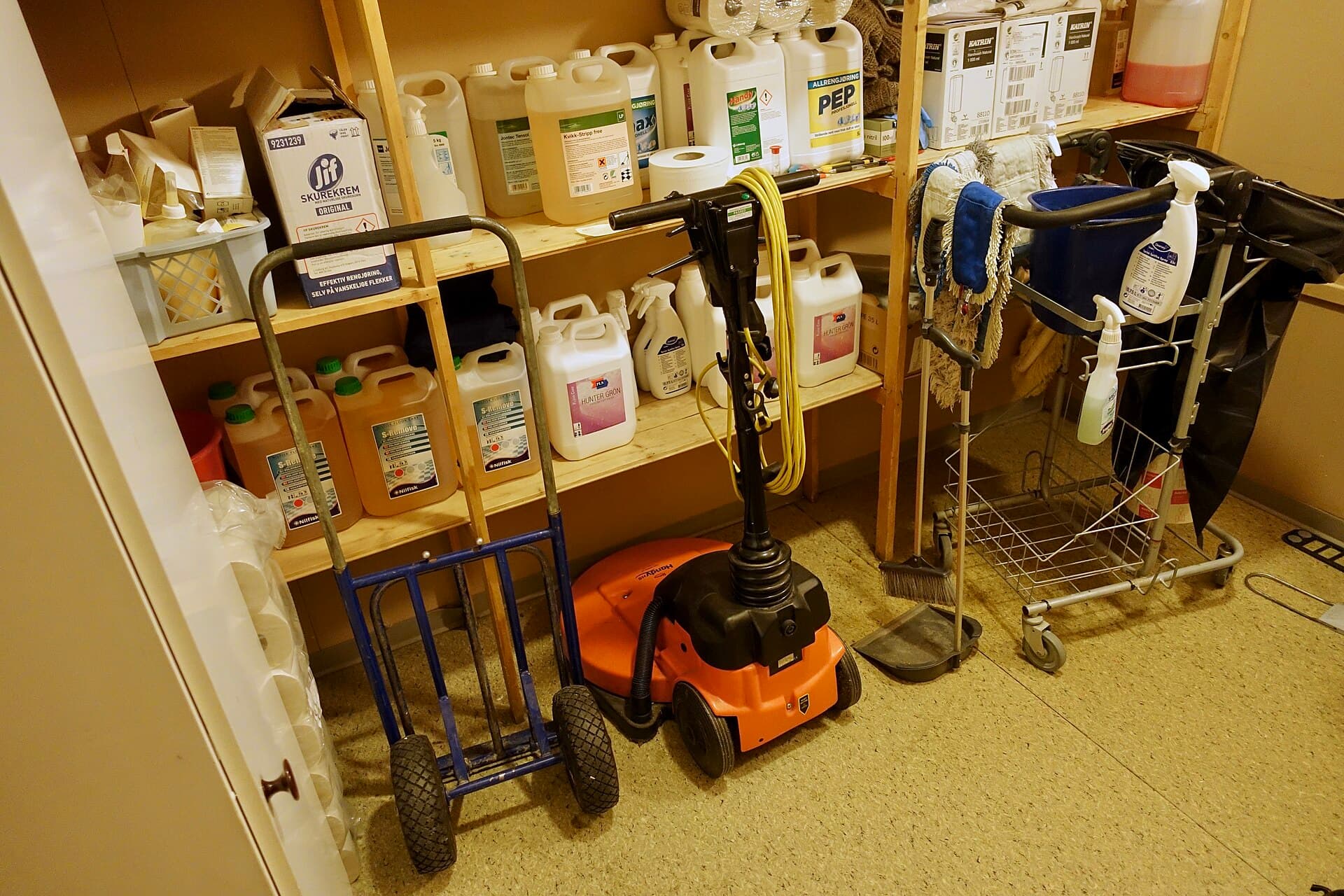
The cleaners’ store is a junk room. Unlabelled bottles and mixed mops teach the wrong lesson. The store is a workplace. Treat it with the same SDS and label rules as the van.
Client staff “borrow” a cloth. A teacher wiping a desk with a red cloth is now your audit finding. Keep the trolley latched if you have to, and tell the facility manager why.
Outbreak weeks. Extra yellow or disposable, extra laundry cycles, a written deviation from the daily program. Do not invent a fogger as a substitute for cloth discipline.
Supervisors should be able to walk a site and call a wrong-colour use without a spreadsheet. If the only person who understands the code is the operations manager in another city, you do not have a system.
Specify it, buy it, inspect it
Put the colour code in the work instruction you submit with the tender, and put a cloth-and-pad count in the consumables line so you are not quietly losing margin. Inspect it the way you inspect glass: look in the buckets, not only at the desk.
Pair it with the chemical register. Pair it with the laundry. Pair it with the machine pads — a floor-scrubber pad that did the amenity lobby should not be the pad that does the servery. The same brain, different textile.
Microfibre and colour-coding will not make a thin roster thick. They will stop the thin roster from spreading the worst of the building around the rest of it. That is the job you actually sold.
Questions contractors ask
- Is colour-coding a legal requirement in Australia?
- There is no single Commonwealth statute that says a toilet cloth must be red. Health services, aged-care operators and many education clients write a colour system into the specification or the infection-control procedure, and WHS duties still require you to manage the risk of spreading contamination. Treat the client’s code as a contract control, and keep one code across your own book so staff are not relearning colours every site.
- Can we wash all microfibre in one commercial load if we bag it by colour first?
- Bagging helps the sort. It does not make a mixed load clean. Colour families should be washed separately, on a microfibre program, without fabric softener, and dried in a way that does not cook the fibre onto a nylon mop. Mixed loads are how a red toilet cloth seeds a blue office load.
- When is a cotton mop still the right tool?
- Heavy organic soil, some outdoor entries, and a few oil-affected industrial floors still wet-mop faster with cotton or a blended loop that you are prepared to launder hot or discard. Microfibre shines on daily damp-wiping and on fine dust. It is a poor broom for mud.