When an autonomous floor scrubber earns its keep
A robot earns a place on an open, repeatable floor with a supervisor who still owns the edges. It does not earn a place because a vendor animated a shopping centre at 2am.
Editorial desk · 11 June 2025 · Updated 20 January 2026
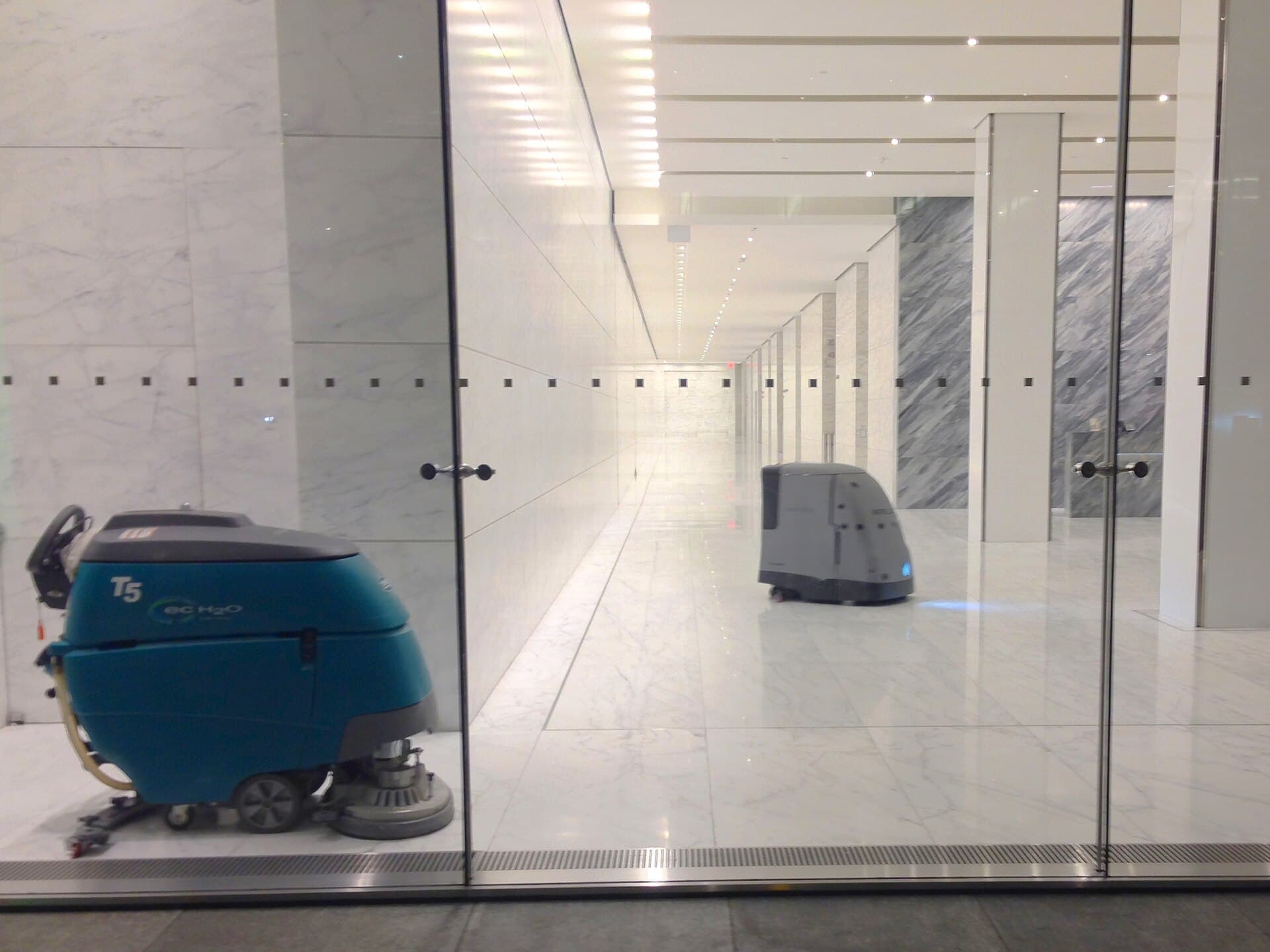
Autonomous floor scrubbers are real machines. They are also the most over-sold item in the chemicals and equipment cupboard. The pitch is always the same: the robot will run the empty centre while your labour goes to the toilets and the glass, the quality will be consistent, and the return will appear before the lease ends. Some Australian sites have made that true. Many have a quiet machine in a cage because the floor was never as empty as the map, the Wi-Fi died, or the only person who could unstick it left the company.
This is not an argument against the technology. It is an argument for buying it the way you buy any other floor machine: against the floor, the roster, the service network and the residual risk, not against a video of a machine that never meets a sandwich board.
What the machine is actually doing
A typical autonomous scrubber is a battery walk-behind or small ride-on chassis with a navigation stack — lidar, cameras, bumpers, sometimes a docking station — and software that follows a mapped path, doses water and detergent, and recovers slurry. It is not a cleaner. It is a scrubber-dryer that can repeat a path without a person holding the tiller.
That definition matters. It will not move a chair. It will not do a threshold the squeegee cannot seal. It will not decide that the deli closed late and the fat is still on the tile. It will not high-dust, and it will not notice the vomit in the lift lobby unless you have paid for a detection feature and then still sent a person. If your specification is a full building, the robot is a specialised labour tool inside that specification.
Mapping is a site project. Someone walks the machine, marks no-go zones, sets docks, and then keeps the map when a retailer moves a gondola. The first fortnight is not “set and forget”. It is two people: one watching the robot, one still doing the building. Budget that, or the trial will look like a failure of the machine when it was a failure of the roster.
Open-plan retail versus cluttered offices
The sites that pay for autonomy look bored on a plan. Long, consistent aisles. A predictable close time. A floor type the squeegee understands. A dock with power. A run that is substantially the same on Tuesday as it is on Sunday.
Supermarkets after trade, large-format retail, airport landside at the right hour, warehouse and logistics plates, some university concourses, some hospital street-corridors — those are the conversations worth having. The machine can cover the metreage that was burning a ride-on operator, and the person can go to the edges, the amenities and the production rooms.
Cluttered offices are the trap. A professional-services floor with hot-desks, bag piles, after-hours project teams, and a kitchen that never quite closes will spend the shift in recovery mode: the robot stops, phones a supervisor, waits. Every chair is a negotiation. Every glass meeting room is a reflection the navigation may or may not like. You will still need a person to do the desks. You have added a machine that needs a person.
Shopping centres sit in the middle. The common mall can be a good robot floor. The speciality precinct with A-frames, temporary retail and a night-fill crew coming the other way is a traffic problem. If the centre manager will not give you a clean window — doors locked, night-fill briefed, security told — do not take the machine out of the box.
Schools are usually a no, except for a large hall and a wide spine on a holiday program. Classrooms are furniture. So are most medical suites.
If you already know from choosing floor machines that the site is a walk-behind site, autonomy will not change the geometry. It will only change who is not holding the handle.
The safety case is not a sticker on the bumper
A moving machine on a floor that members of the public, security, night-fill or a cleaner might occupy is plant. You already have WHS duties for plant. Autonomy adds residual risks the manufacturer cannot wish away: the machine does not see everything, people do not hear everything, and a building at night is not the digital twin.
Write the assessment as you would for any new ride-on, then add the autonomy-specific questions:
- When is the area permitted to be occupied, and who controls that?
- What is the maximum speed in each zone, and who can change it?
- What does the machine do at a glass wall, a stair, a travelator, a loading-dock lip?
- Who receives the alert when it stops, and what is their response time if they are in another building?
- How is emergency stop taught to client staff and security, in language they will remember?
- What is the isolation procedure for maintenance, including the battery dock?
- Where is the SWMS, and who is named as supervisor?
Some manufacturers publish a residual-risk file and a declaration against relevant machine-safety standards. Read it. Do not replace it with a one-page “the robot has sensors”. Sensors reduce risk; they do not retire the duty.
Night work adds the lone-worker problem you already carry. A robot is not a companion. If your cleaner is now alone because “the machine is doing the floor”, you have changed the after-hours risk, not reduced it. Duress, check-in and the security relationship still matter.
Public-facing sites should think about children and about people who will treat the machine as a toy. A weekend centre with trading hours is a different case from a locked supermarket. Do not run the optimistic map in the optimistic hours.
Victoria’s OHS framework and the model WHS jurisdictions will both ask whether you identified the hazard and controlled it so far as is reasonably practicable. The paperwork should be able to show that without a vendor logo in the header.
Night security, alarms and the building that is not yours
Autonomous machines have a talent for finding the one motion detector you forgot, the one fire-door that does not like a nudge, and the one comms cupboard whose Wi-Fi you were using without asking. Involve the client’s security contractor before the trial, not after the first false alarm.
Practical items that kill trials:
- Alarm sectors that must stay armed while you want the robot in the mall.
- Fire-isolation doors that close on a timer and trap the machine in a tenancy.
- After-hours lighting that drops below what the cameras need — or lighting that security will not leave on for your power bill.
- Lifts. Most robots do not take lifts unless you have paid for that problem and a person to escort.
- Loading docks with forklifts. A robot and a forklift sharing an aisle is a traffic plan, not a feature.
Access control is a live issue. The dock is often in a locked room. Someone has to have a key or a fob at 3am when the machine reports a full recovery tank. That someone is on your key register. If the plan is “it will dock itself and we will look in the morning”, confirm the tank and the pad will last that long on the dirtiest night, not the demo night.
Cyber and data sit in the same conversation as keys. A machine that maps a building and phones home is a device on someone else’s network, or on a vendor cloud. Ask where the map lives, who can download it, and how you wipe it when you lose the contract. Facilities managers who already dislike your master key will dislike an undocumented robot account more.
ROI without the fairy tale
Return on investment is a sum, not a feeling. Write it on one page with numbers you can defend.
Costs you will actually pay. Capital or lease. Delivery and training. Mapping labour for the first weeks. Consumables at the same rate as a human-run machine of that size — pads, squeegees, detergent, filters. Battery replacement on the manufacturer’s cycle. Software subscription if there is one. Connectivity. Service labour and travel, especially outside the capital cities. The hours of a person who still has to empty, charge, change pads, rescue, and inspect.
Hours you will actually save. Only the scrubbing hours the robot reliably takes on nights it runs. Subtract nights it cannot run: events, flooding, a fit-out, a failed dock, a map that broke when a tenancy moved. Subtract the inspection time you still owe the client. Do not subtract toilet hours you never planned to give the robot.
Quality you will actually hold. A robot that runs the same path can be more consistent than a tired operator on an empty concourse. It can also polish a missed edge into a habit. Someone still walks the floor with a torch. If your quality system is already thin, a robot will not thicken it.
Contract length. A three-year retail contract and a five-year lease is how contractors buy a machine for the next tenderer. Match the money to the term, or have a second site that can take the unit.
Labour market. Autonomy is more attractive where you cannot hire a ride-on operator at 2am and the floor is killing the roster. It is less attractive where labour is available and the site is fiddly. Do not let a vendor diagnose your labour market for you.
Refuse percentage claims that do not name the site type. “Saves half a cleaner” on a 2,000-square-metre open supermarket after close may be plausible. The same sentence on a 2,000-square-metre office is fiction. If you cannot time the current human run on that floor, you are not ready to model a robot.
Regional service is the same constraint we apply to ordinary scrubbers, only sharper. A specialist board and a software login that only the state distributor understands will park a six-figure machine. Ask for the technician’s location, the parts list they stock, and what happens to the map if the unit is swapped. Get it in the quote.
Trial like a sceptic
A paid or tightly scoped trial on the real night, with your supervisor writing notes, is the only demo that counts. Run it on the dirty nights. Measure water, pad wear, stops per hour, and the time a person still spent on that floor. Ask security for the alarm log. Ask the cleaner whether they trust it enough to start the amenities first, or whether they hover.
Write a stop rule. If the machine cannot complete the nominated zone without a rescue more than an agreed number of times a week, it goes back. Vendors who will not accept a stop rule are selling a story.
Keep the manual machine. The robot will have nights off. The contract will not.
If the trial holds, write the robot into the work instruction, the SWMS, the chemical register (it still doses a product that needs an SDS), and the client’s after-hours plan. If it does not hold, you have learned something cheaply about that site. That is a better outcome than a quiet, expensive cupboard.
Questions contractors ask
- Can an autonomous scrubber replace a night cleaner?
- It can take a slice of open-floor scrubbing time. It cannot do toilets, desks, glass, spills that happen after it has passed, or the conversation with security when a door is propped. Price the hours you still have to roster, not the hours on the sales slide.
- Do we need a formal safety case for a robot on a public concourse?
- You need the same WHS risk assessment you would write for any machine that moves in a place people walk — plus the manufacturer’s residual-risk information, a traffic-management plan, and a rule for what happens when the centre is not as empty as the map. Some clients will ask for that pack before they let you map the site.
- What is the honest first site to trial?
- A large, repeatable floor you already clean well with a ride-on or a walk-behind — a supermarket after close, a campus concourse, a warehouse aisle — with a nearby technician and a supervisor who will tell you the truth after a month. Not the cluttered professional-services office you are about to lose.