A 30-day induction for new cleaners that actually sticks
Day-one WHS, colour-coding, keys and a shadow shift are not a welcome pack. They are the only reliable way to put a new cleaner on a solo night without gambling the building, the award classification or the next compensation claim.
Editorial desk · 2 April 2025 · Updated 9 February 2026
Most cleaning inductions in this country are a folder, a hi-vis vest and a hope. The new starter signs a safe-work method statement they have not read, walks a building in daylight, and is handed a set of keys for a night they will work alone. When the client calls at 7am about a wet foyer or an unsecured pharmacy cupboard, the contractor discovers that “they said they had done nights before” is not a training record.
A 30-day induction is not hospitality. It is the period in which you decide whether this person can hold a building after dark without hurting themselves, the occupants or your contract. It belongs in the operations and workforce hub next to rostering a night crew, because an induction that “saves a week” is how you put an untested person on a 2am lone shift. This is not legal advice. Check the current award, the model WHS laws as they apply in your state or territory, and the client’s own site rules.
Day one is WHS, not the mop
The first shift is for hazards, not productivity. A person conducting a business or undertaking has to induct workers into the risks of that workplace: chemicals, plant, manual handling, lone work, after-hours access, and the people who will still be in a 24/7 building. Safe Work Australia’s hazardous-chemical duties are specific enough to write a day-one list from: correct labels on every container, safe storage, an up-to-date register with a current safety data sheet for each product, and training in the product that person will actually pour, not a generic “chemical awareness” slide.
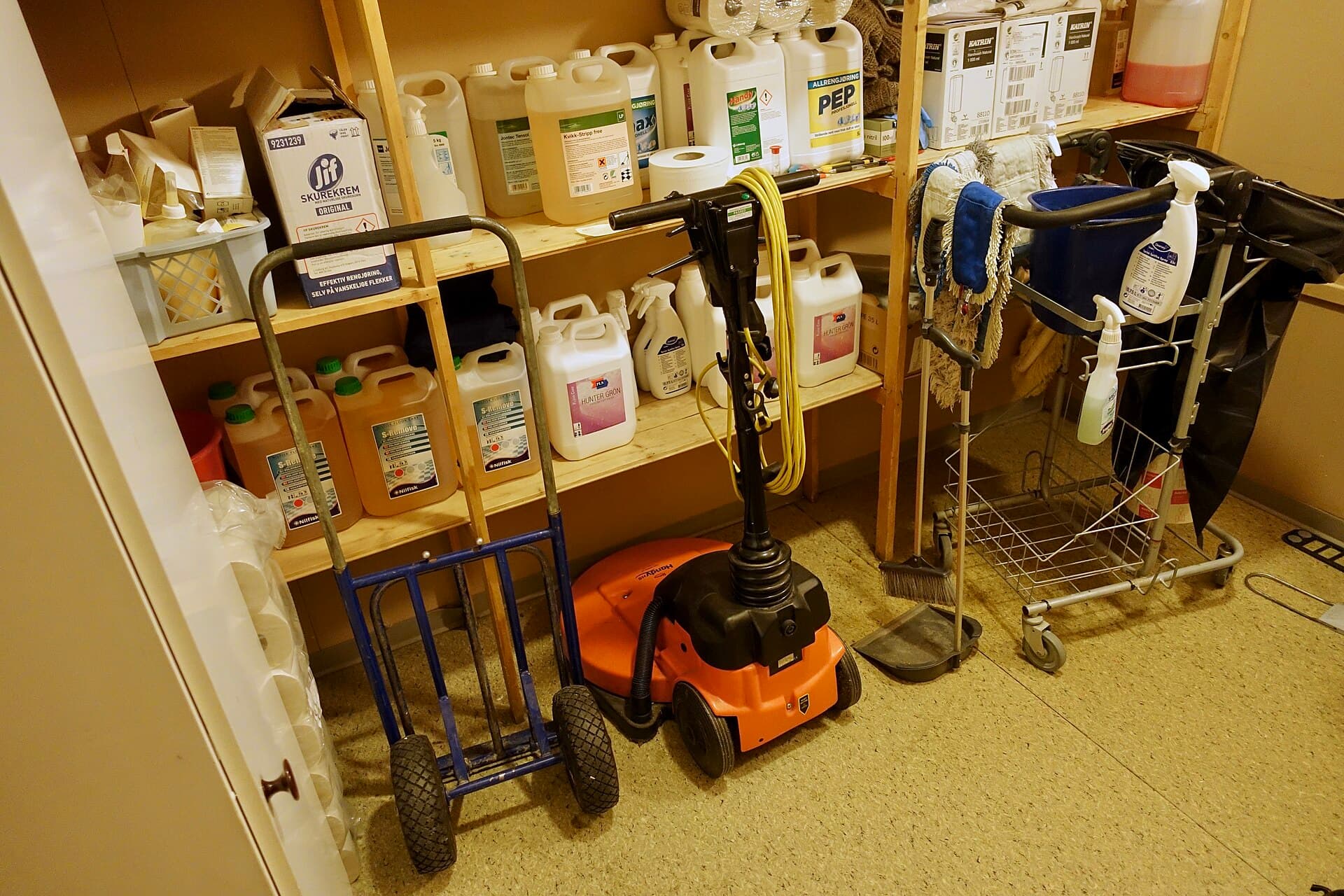
Do the cupboard first. Show the decanting bench, the original containers, the dilution bottles, the spill kit, the PPE that matches the SDS, and the bin for empty containers. If a product has been poured into a drink bottle, stop the shift and treat that as the induction. Many commercial sites still run a small set of neutrals, a washroom product, a disinfectant and a floor maintainer. That is enough chemistry to harm someone if the labels lie.
Manual handling is the other day-one killer. Mop buckets, wet vacs, roll cages, sanitary bins and the walk-behind scrubber all produce the same claims: shoulders, backs, knees. Demonstrate the lift, the wheel, and the rule that a machine with a dead battery is not dragged up a ramp. Plant induction is model-specific. “Has used scrubbers before” is not a record for the machine on this site. Write the model, the date, and who signed them off.
Lone work and after-hours rules sit on day one because that is when people are tempted to skip them. How do they check in? Who answers? What do they do if a door will not lock, an occupant will not leave, or they feel unsafe in a car park? A mobile number on a whiteboard is not a system. If the night roster already runs thin, do not make the new starter the person who discovers it.
Give them the Fair Work Information Statement on day one, and the Casual Employment Information Statement if they are casual. That is an NES requirement, not a nicety. Tell them their classification, employment type, usual location and ordinary hours, which clause 8 of the Cleaning Services Award already requires you to record.
Colour-coding is a habit or it is nothing
Commercial cleaning borrowed colour-coding from health and never quite finished the job. NSW Health’s environmental cleaning procedures still set the reusable-equipment colours that most Australian hospitals, and a growing number of education and commercial specifications, treat as the default: yellow for infectious and isolation areas, red for toilets, bathrooms and dirty utilities, green for food services and food preparation, blue for general cleaning, and white for operating theatres. If your contract is not a hospital, you may not need white. You still need a rule that a red mop does not visit a kitchen.
Teach it as a physical drill, not a poster. Put the new cleaner in front of the cupboard and ask them to set a trolley for a toilet, then for a tea room, then for an isolation room if the site has one. Watch which cloth they take. Watch whether they change solution between areas. Watch whether they wipe the handle. A signed poster in the cleaners’ room has never stopped a red mop in a food-prep area at 9pm.
Microfibre systems make the drill easier and the cheating easier. A colour-coded cloth pack only works if the used cloths go into the right bag and the laundry (on-site or off-site) does not mix them. If you use disposable cloths, the same colours apply and the bin is part of the method. Do not run “whatever is clean” on a Friday because the laundry is late. That is how you teach the new starter that the poster is decoration.
Client sites will overlay their own rules — allergen kitchens, laboratories, early-childhood bathrooms, pharmacy clean rooms. The induction record should say which colour system applies on which site, not “industry standard”. If you hold a school by day and a clinic by night, the same person needs both drills before they work either site alone.
Keys, cards and the building you are about to hand them
Access is a security process that contractors treat as stationery. Day one should include: which keys exist, which cards, which codes, which cabinets they open, what is out of bounds, and how a lost key is reported. Walk the lock-up sequence in the order they will do it at the end of the night, not the order that suits a daytime supervisor.
A new cleaner does not need the master on week one. They need the doors for their area, a documented sign-in with security or a night dock, and a rule that keys are not photographed, not taken home in a jeans pocket if the contract forbids it, and not lent to a mate who is “helping”. If the site uses a keywatch cabinet or an electronic audit trail, show them how their name will appear on it. People treat keys more carefully when they know the cabinet keeps minutes.
Alarms are where inductions usually fail. A code written on a card in the cupboard is a gift to anyone who empties the bin. Use the client’s official process. Practise arming and disarming with the person who holds the account, during a window that will not call the police. Write down what to do if the panel faults. A cleaner who has never seen the keypad will not remember a paragraph in the site folder at 11pm.
Phones and photos belong in the same conversation. Some clients forbid cameras in clinical or justice settings. Some require photo evidence for quality inspections. Tell them which is which before the first shadow shift, or you will spend the second week arguing about a picture of a dirty sink that also shows a patient board.
Shadow shifts are the job, not a courtesy
A shadow shift is the new cleaner working the real hours, on the real floor, with a competent person who still owns the result. Daylight walks do not teach night work. Night is when the building changes: motion lights, locked internal doors, cleaners’ cupboards that share a riser with the hot water, occupants who work late, and the particular squeak of a loading-dock roller that means you wait.
Structure the shadows. Week one, they watch and do the simple rooms under supervision. Week two, they own a wing while the buddy stays in earshot. Week three, they run the machine or the isolation clean with the buddy auditing. Week four, they run the shift and the buddy arrives for lock-up and a debrief. If that sounds expensive, compare it with a lost contract, a chemical burn, or a workers compensation claim that starts with “they had been shown once”.
The buddy is a trainer, which means a classification and a skill, not “the person who speaks the same language and is not on leave”. A Cleaning Services Employee Level 2 may already be expected to assist with on-the-job training. A Level 3 coordinates it. Pay the function. If the only trainer you have is a tired leading hand covering two sites, you do not have an induction. You have a conversation in a car park.
Write what was covered on each shadow: which rooms, which machine, which chemical, which incident. A timesheet that says “training” is not evidence. A one-page checklist with the buddy’s name and the site is.
Language, literacy and the documents we pretend people read
A large share of the Australian contract-cleaning workforce speaks a language other than English at home, or reads English slowly when they are tired. That is not a character flaw and it is not a reason to skip the SDS. It is a reason to stop using a ten-page English SWMS as the only control.
Organise the hierarchy that actually works on a night floor. Demonstrate, then get them to demonstrate. Label the cupboard in the language you share if you have a stable crew who use it — and keep the English SDS with the product, because that is the legal document. Pictograms on dilution bottles beat paragraphs. A bilingual buddy for the first fortnight beats a translated PDF nobody opens. If you use video, shoot the actual cupboard and the actual machine, not a supplier’s European clip.
Literacy also covers numbers. Dilution ratios, contact times, and the difference between a 1:10 and a 1:100 are how you either sanitise a bathroom or bleach a vinyl floor. Test it with water first. If they cannot make up a bottle to the mark without coaching, they are not ready for concentrate.
Do not hide behind “they signed it”. A signature on an English form from someone who cannot explain the spill procedure is a document for your insurer, not a competent worker. The WHS duty is that they understand the risk. The editorial standards for this journal are the same idea in another register: if the method cannot be recognised by a competent person on the tools, it is not a method.
Probation is not a legal holiday
Employers like the word probation because it sounds like a free month. It is not. If you employ the person — full-time, part-time or casual — the Cleaning Services Award and the National Employment Standards apply from the first hour. Ordinary pay, penalty rates, the part-time or casual loading that applies, superannuation (12 per cent of ordinary time earnings from 1 July 2025), and the leave rules for that employment type do not wait for a “confirmation” email.
Probation, if you use it, is a contract clause about how you will review suitability and how much notice you have agreed to give. It does not authorise a lower classification than the work, a cash job, or a trial week off the books. The Fair Work Act’s minimum employment period before most unfair-dismissal applications can be made — generally six months, or 12 months for a small-business employer — is a separate statutory waiting period. It is not a substitute for notice, and it does not make a dismissal automatically fair. Get advice if you are ending employment. Do not take a Facebook rumour as the process.
Casual engagement has its own award limits. Clause 11.1 only allows casuals to be engaged for intermittent or irregular work, uncertain hours, or to replace a full-time or part-time employee who is rostered off or absent. A “casual” who works the same 38 night hours every week from week one is a classification and conversion argument waiting for the NES casual-conversion pathway. If the business model is ongoing nights, employ them that way, or be honest about subcontracting versus employing and the sham-contracting risk of an ABN that is really a job.
Set the review points in the diary before they start: end of week one (safety and attendance), end of week two (quality on the shadowed wing), end of week four (solo competence). Tell them what “good” looks like in the rooms they clean, not in slogans. A person who is failing a night program should hear it on day ten, with a specific room and a specific method, not on day 29 with a termination letter.
What you test before anyone works a solo night
Do not send them alone until they can do all of the following on the actual site, on the actual shift, without the buddy prompting:
- Select PPE and the right colour equipment for the area, and change it between toilet, food and general spaces.
- Dilute the products they will use, read the first-aid directions on the SDS, and show the spill response.
- Run the machine they will run, including emptying, charging and a stop if it faults.
- Follow the access and lock-up sequence, including alarm, keys and the rooms they must not enter.
- Check in under the lone-work rule and say who they call for a needle-stick, a slip, an aggressive occupant or a water leak.
- Finish a defined area to the standard you will inspect, including edges, and say what they skipped because they ran out of time.
That last point is more important than a perfect toilet. Night work is always a negotiation with the clock. A cleaner who hides an unfinished corridor is more dangerous than one who radios and tells you the machine died. Teach the radio. Then inspect as you mean to continue; the method in cleaning quality inspections should be the same method they were trained against, not a surprise audit form from a different contractor.
If they cannot meet the list, extend the shadow. If they cannot meet it after 30 days, they are not a night cleaner on this book yet. That is a cheaper conclusion than a burned floor, a lost master key or a claim. Do not use them as silent weekend cover either — a person who is not ready for a Tuesday night is not ready for a Sunday no-show. Put the 30-day pack in the same folder as the roster, the SDS and the site specification. When a client or a regulator asks what “inducted” meant, you should be able to show the days, the buddy, the tests and the date they were first left alone — and not a signature from a lunch room they have already forgotten.
Questions contractors ask
- Is a half-day site walk enough before a solo night?
- No. A walk shows where the toilets are. It does not test chemical dilution, colour-coding, lock-up, alarm codes, lone-work check-in or what to do when a scrubber fails. Keep the new cleaner with a competent person until those items have been demonstrated on the real shift, not described in the lunch room.
- Does a probation period let me skip award entitlements?
- No. Probation is a contract term. The National Employment Standards and the Cleaning Services Award still apply from day one, including pay, penalties, super and most leave rules that attach to the employment type. Unfair-dismissal waiting periods are a separate Fair Work Act question and do not authorise underpayment.
- What if the new cleaner has limited English?
- Then the induction is a language job as well as a cleaning job. Use demonstrated practice, labelled equipment, photos and a bilingual buddy where you have one. Do not treat a signed English-only SWMS as proof of competence. If they cannot show the right cloth and the right dilution without coaching, they are not ready for a solo night.